
A note from our Clinical Director
Thank you for being here.
Thank you for wanting to understand what’s happening in your body. That curiosity is where better care starts.
Too many of us in our late 30s and 40s are going through the same thing. We aren’t sleeping. We feel anxious for the first time in our lives, can’t think straight and ache in places we never did. Our periods are still regular, so we’re told we’re too young. We leave with a sleep aid, an antidepressant or nothing at all.
That’s why I stopped seeing patients and started building a better model of care: longer appointments, real diagnostics and outcomes that get measured.
Perimenopause can touch your sleep, mood, memory, joints, skin and sex life. You deserve care that looks at all of it.
This checklist is where that starts. Fill out the form and I’ll send it your way.


Clinical Director, Nava Health
The Perimenopause Checklist
Get your free perimenopause guide.
Perimenopause can start years before your period changes, and most of its signs have nothing to do with your cycle. This PDF includes 40 of them across 10 body systems, so you can see the whole picture and bring it to your next appointment.
Fill out the form below to download the free PDF.
Your information is never sold. By submitting you agree to recieve emails from Nava health. View our Privacy Policy.
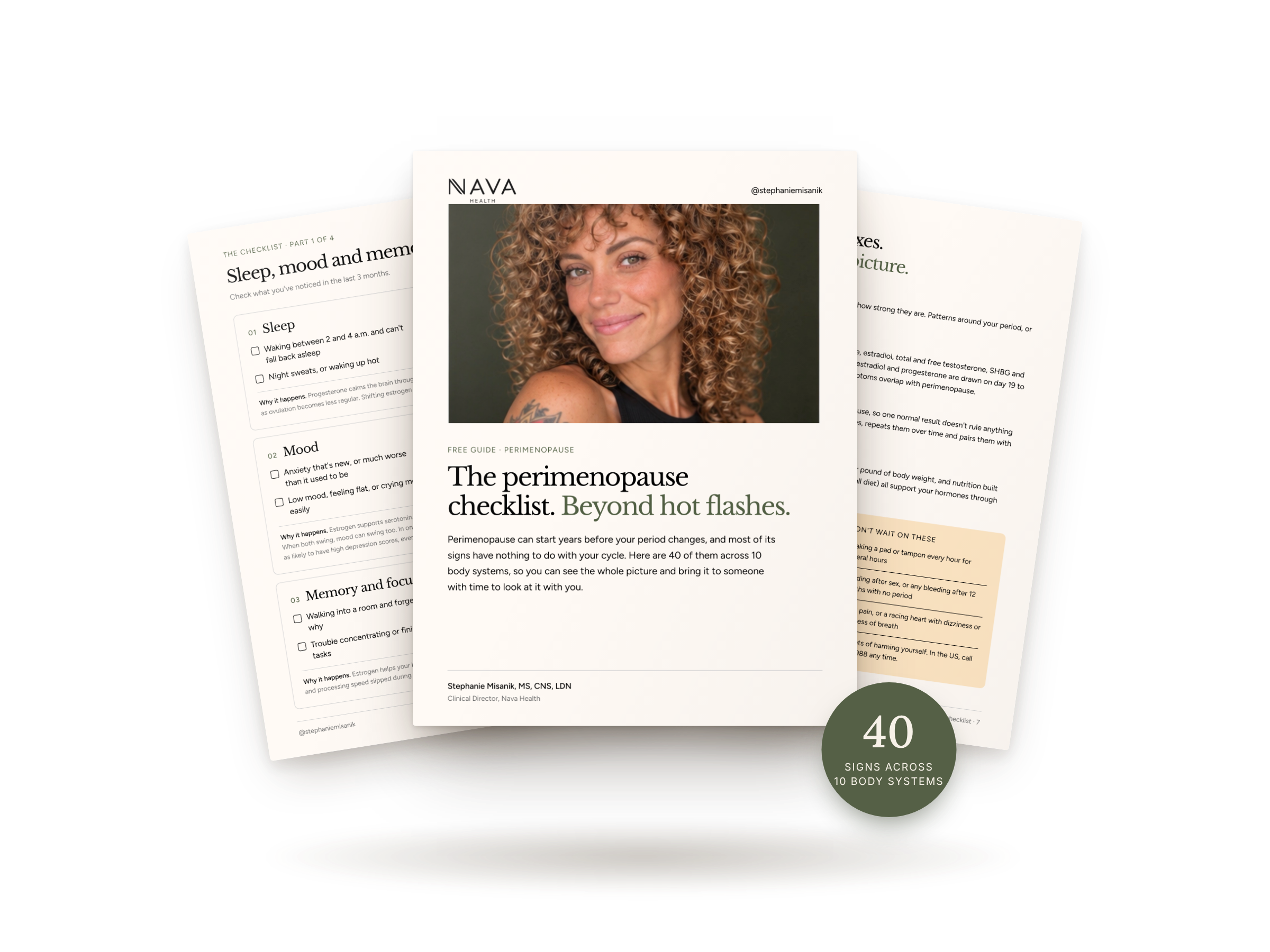
FREE GUIDE · PERIMENOPAUSE
You’re not imagining it. And you’re not too young.
Perimenopause can start years before your period changes. Our free checklist covers 40 signs across 10 body systems, so you can see the whole pattern and bring it to your next appointment.
Here’s what’s in the guide:
- 40 signs, from 3 a.m. wake-ups to achy joints to brain fog
- A short “why it happens” for each body system
- The questions to ask your provider, including which labs to request
- Red flags that shouldn’t wait
Meet Stephanie
Stephanie Misanik, MS, CNS, LDN
Stephanie Misanik, MSACN, CNS, LDN, is a functional medicine practitioner and Clinical Director at Nava Health, with more than a decade of experience. She specializes in women’s health, perimenopause, sports nutrition, and hormone optimization.
She co-hosts Longevity Unfiltered, where she explores personalized longevity science and healthcare. On Instagram and TikTok, Stephanie shares practical guidance on root-cause medicine, hormone changes, personalized lab tracking, and nutrition for women and young athletes.


The Problem
Perimenopause rarely shows up as one symptom. It shows up as a pattern.
You wake up at 3 a.m. You feel anxious for no reason. You walk into a room and forget why. Your jeans are tight, but nothing about your routine has changed. And your period still shows up on time, so you’re told it’s probably stress.
Stress is real. So is perimenopause. When each symptom gets looked at on its own, the pattern gets missed. This checklist puts the whole picture on one page.
What’s inside
40 signs of perimenopause across 10 body systems.
Plus: a simple scoring guide, a “Top 3” tracker, the labs worth asking about and 4 questions to bring to your next appointment.
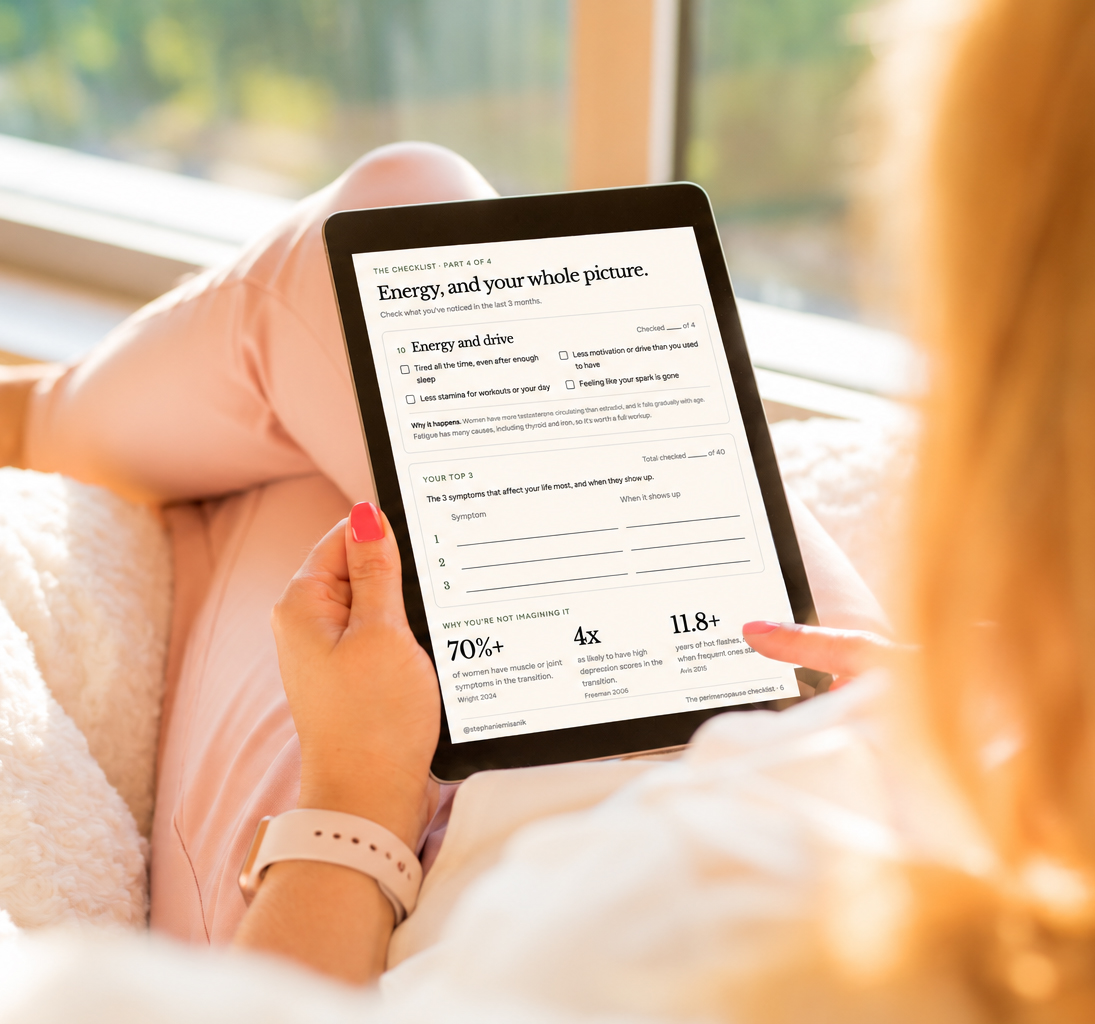
Sleep and energy
Waking between 2 and 4 a.m., night sweats, or feeling tired after a full night in bed. Less drive, less stamina, and the sense that your spark is gone. The guide explains how falling progesterone can disrupt sleep and why fatigue deserves a full workup.
Mood, memory and focus
New anxiety, a shorter fuse, feeling flat, losing words mid-sentence, or walking into a room and forgetting why. Learn how shifting estrogen and progesterone affect your brain’s calming and focus signals.
Hot flashes and heart
Waves of heat, sudden sweating, or a racing, pounding heartbeat. These can start while your periods are still regular, and the guide shows how long they can last.
Your cycle
Periods that come sooner or later, run heavier or bring worse PMS. See which changes are common and which bleeding patterns need a call to your provider right away.
Weight, muscles and joints
Weight gain around your middle with no change in habits, slower recovery, morning stiffness or new aches in your shoulders, hips or hands. Find out why muscle, joints and metabolism change during this transition.
Skin, hair and nails
Drier skin, thinning hair, new breakouts or brittle nails. The guide explains the hormone shifts behind these changes.
Sex and bladder health
Lower desire, vaginal dryness, more UTIs or leaking when you laugh. These are common, treatable and often go unmentioned. The guide gives you the words to bring them up.
Built from the research. Written for real conversations.
Backed by 12 peer-reviewed sources, all listed in the guide.
of women have muscle or joint symptoms during the transition (Wright, 2024)
as likely to have high depression scores during the transition, even with no history of depression (Freeman, 2006)
years median duration of hot flashes when frequent ones start early (Avis, 2015)
Frequently Asked Questions
Have questions about this free guide?
Is it really free?
Yes. Enter your email and the checklist downloads right away. We’ll also send a copy to your inbox.
Can I have perimenopause if my period is still regular?
Yes. Hormones often shift years before your cycle changes. That’s one of the main reasons we made this checklist.
Is this a diagnosis?
No. It’s a tool for a better conversation with your provider. It is not medical advice.
Do I need to be a Nava patient?
No. Use it with any provider.
FREE GUIDE · PERIMENOPAUSE
Bring the whole picture to your next appointment.
One page that connects the 3 a.m. wake-ups, the brain fog and the achy knees. Check what fits, circle your top 3, and walk in with something your provider can’t brush off as stress.